Airport infrastructure concrete in Montana must withstand aircraft loads, freeze-thaw cycles, deicing chemicals, moisture intrusion, and reactive aggregates. The right approach combines condition testing, compatible repair mortars, effective drainage, joint maintenance, and penetrating protection to extend pavement useful life while keeping runways, aprons, terminals, and parking structures operational. For a broader look at DOT-spec repair workflows, see our Montana DOT concrete repair guide.
Montana Airport Concrete: Engineering and Funding Context
Montana airport projects demand coordinated engineering, funding, phasing, and material selection. The Federal Aviation Administration establishes standards for federally funded airfield construction, while airport owners must document that designs, materials, testing, and construction remain in compliance with current grant-assurance requirements.
Bozeman is home to Montana's busiest passenger airport. Bozeman Yellowstone International Airport reported more than 2.6 million total passengers in 2024, placing it ahead of Billings, Missoula, Kalispell, and Great Falls. Billings Logan International Airport remains a major commercial, cargo, medical, and regional transportation center; its primary Runway 10/28 extends 10,518 feet.
Federal Funding and FAA Compliance
Federal funding directly affects which Montana airport projects advance. Congressional appropriations support Airport Improvement Program grants, while Infrastructure Investment and Jobs Act funding created additional airport terminal and infrastructure awards. Owners should confirm the grant amount, project scope, local match, and eligible costs in FAA award records before procurement.
Funding does not correct poor specifications. Owners need repair systems matched to substrate condition, exposure, placement depth, cure window, and aircraft reopening requirements. For over 15 years, Montana Concrete Products has supplied industrial-grade repair and protection materials to contractors, municipalities, and agencies nationwide — learn more on our about page.
ASR Mitigation at the Billings Airport Commercial Apron
Cracking across an apron may indicate more than surface wear. At the Billings airport commercial apron, investigation identified distress associated with alkali-silica reaction (ASR) — a chemical reaction involving reactive silica in aggregate, alkalis in cement paste, and moisture.
ASR gel absorbs water and expands, creating internal pressure. Warning signs include map cracking, joint displacement, pop-outs, gel deposits, and recurring cracks after surface repairs. Because aircraft pavements carry concentrated wheel loads, progressive cracking can lead to loose fragments, foreign-object debris, reduced load transfer, and unplanned gate closures.
A defensible mitigation process follows five steps:
- Map distress and review concrete placement records
- Extract cores for petrographic examination and strength testing
- Determine whether ASR, freeze-thaw damage, drainage, loading, or several mechanisms caused the failure
- Remove unsound concrete and install a compatible, low-shrink repair system
- Reduce future moisture entry through joints, drainage corrections, and penetrating protection
Repair and Protection Systems for Airport Concrete
The best airport concrete program converts technical controls into fewer closures and more predictable budgets. Montana Concrete Products supplies DOT-spec repair mortars, waterproofing treatments, and professional sealers for contractors, municipalities, and infrastructure owners nationwide. Material selection should address bond strength, modulus, shrinkage, working time, cure temperature, and return-to-service requirements — a fast-setting product is valuable only when crews can place, finish, and cure it correctly within the closure window.
- Spalled apron or terminal concrete: remove unsound material and place compatible repair mortar to restore edges and load-bearing surfaces before debris reaches aircraft areas
- Moisture-driven deterioration: correct drainage and apply suitable penetrating protection to limit water entry that accelerates freeze-thaw damage and ASR
- Failed joints: clean, rebuild, and reseal joints to reduce incompressible material, water infiltration, and slab-edge spalling
- Active structural movement: test the substrate and obtain an engineered repair design to prevent repeated spending on cosmetic patches
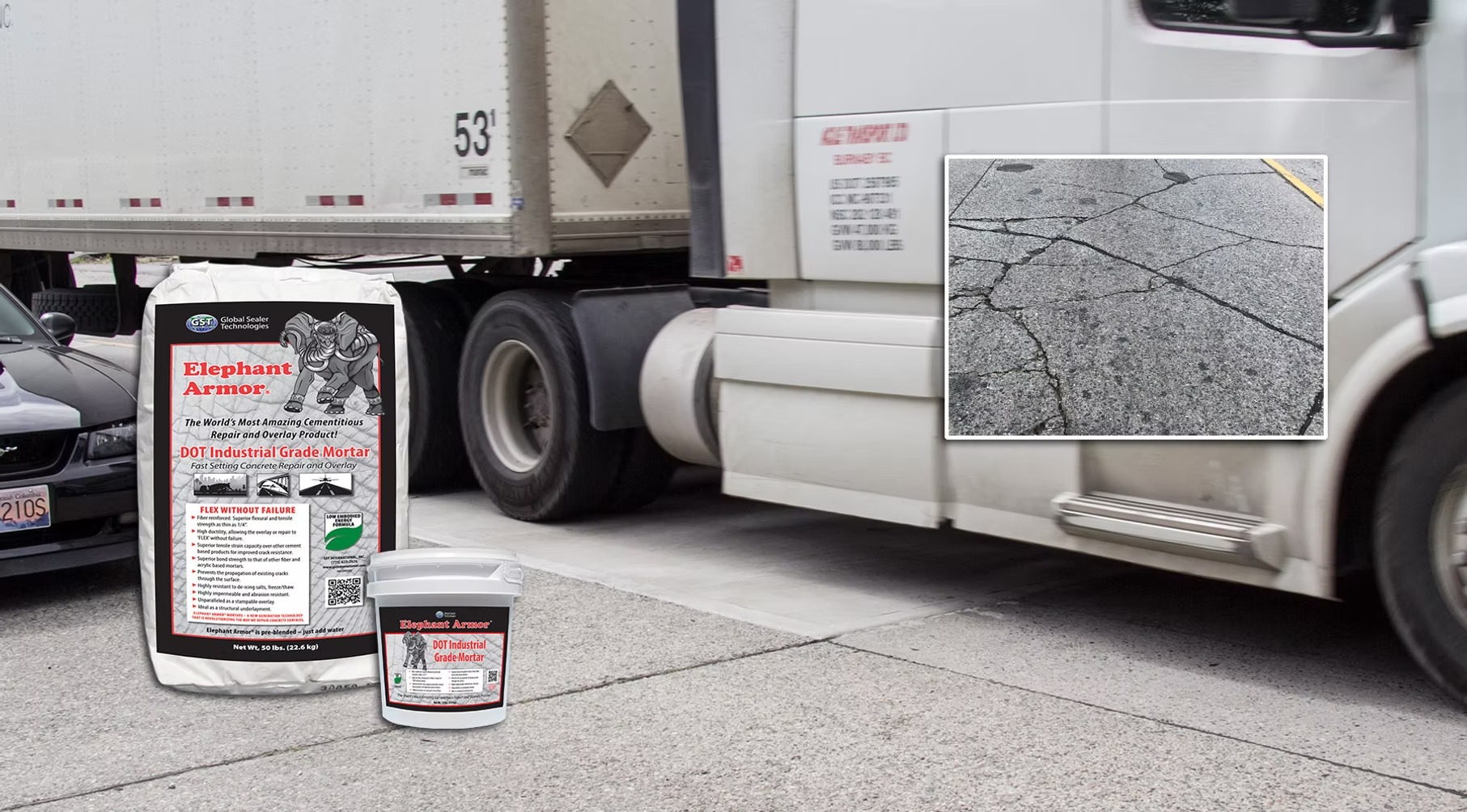
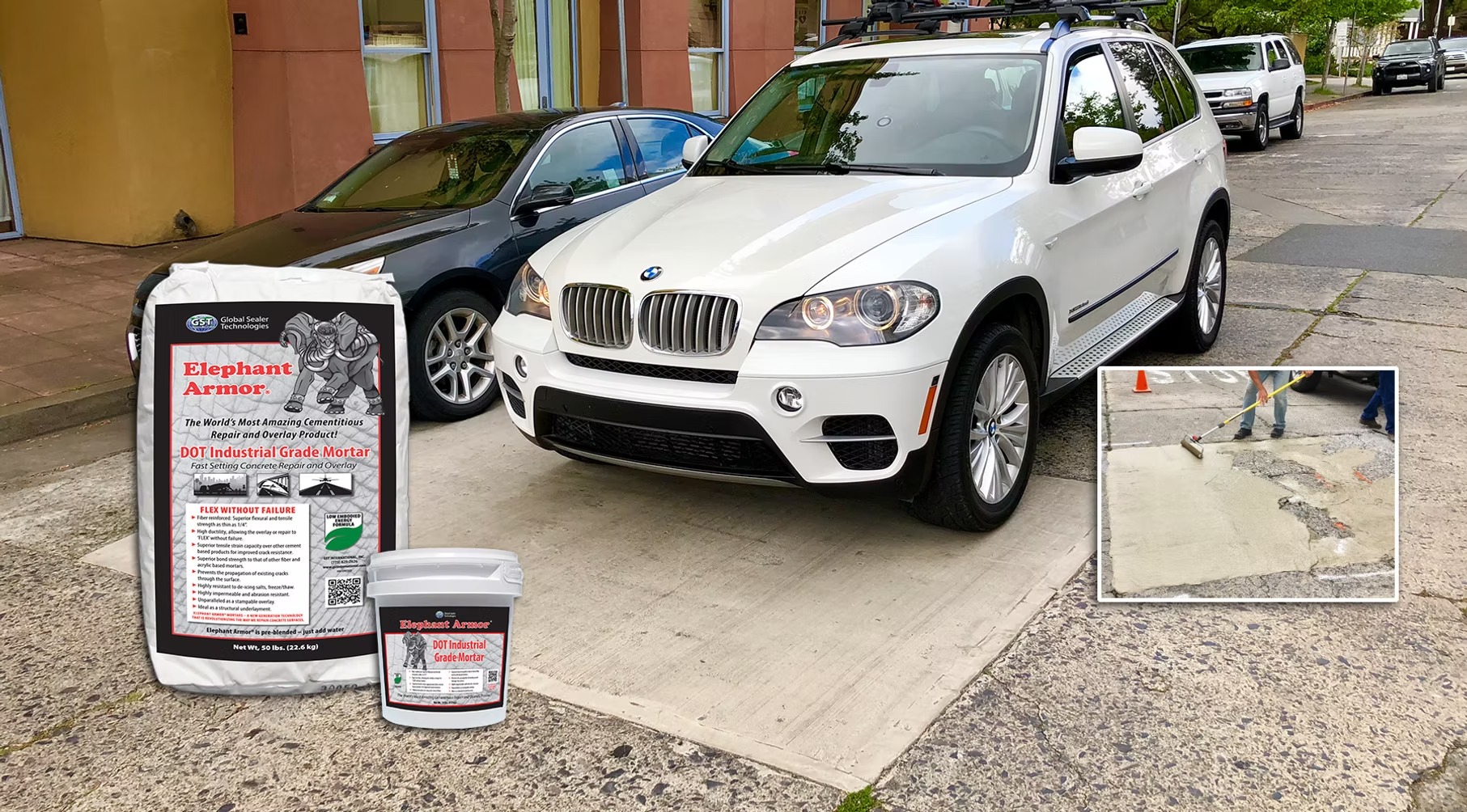
For spall and edge repairs on aprons, taxiways, and terminal slabs, Elephant Armor DOT Concrete Repair Mortar achieves 4,000 psi in 4 hours and is engineered for freeze-thaw and deicing salt exposure. Every cementitious application requires EA Primer as a bonding agent. Browse the full Surface Repair category for all repair mortars and bonding agents.
ASR: A Problem New to Montana
ASR is not new science, but confirmed airfield cases can be unfamiliar to Montana owners and contractors. Research through Montana State University civil engineering can help expand regional knowledge of aggregate reactivity, supplementary cementitious materials, and exposure conditions.
Prevention starts before placement: test aggregate sources, control total alkali loading, select proven supplementary cementitious materials, and design drainage that keeps slabs from remaining saturated. Existing concrete requires a different strategy: diagnose the reaction, limit moisture, maintain joints, repair hazards, and monitor movement. Surface sealing alone cannot reverse internal expansion, but Vetrofluid penetrating waterproofing can reduce the moisture that feeds the reaction by densifying the pore structure from within.
Billings Airport Storm Drainage System
Storm drainage protects pavement foundations by moving runoff away from slabs, joints, and base materials. At Billings-Logan International Airport, drainage planning must account for snowmelt, intense storms, airfield grading, secure-area construction, and continuous aircraft operations. Better drainage reduces saturation, pumping, settlement, and freeze-thaw exposure. Vetrofluid penetrating waterproofing complements drainage design by reducing the moisture that reaches the pore structure even when surface conditions stay wet.
Billings Airport Terminal Concourse Expansion
Billings completed a terminal modernization valued at approximately $60 million, with approximately 140,000 square feet of renovated and expanded space. Although that major program is complete, related capital planning continues around apron condition, passenger facilities, utilities, and operational assets. Owners should separate active construction from completed reference projects when reviewing any project announcement.
Bozeman Yellowstone Airport Parking Garage
The Bozeman Yellowstone Airport parking garage added more than 1,100 spaces when it opened in 2019. Structured parking demands durable decks, sealed joints, drainage, corrosion control, and protection from deicing salts. The same principles apply to every Montana airport: keep water out, move it away, and repair defects before reinforcement corrosion expands them. For masonry and stone elements on terminal facades and parking structures, Brick & Stone Cover provides invisible, breathable water repellency that lasts 10 years or more.
An Investment in Our Future
Concrete preservation protects more than the original amount invested in a project. It supports emergency flights, tourism, freight, construction schedules, and reliable access to rural communities. Planned inspection also lets owners repair isolated deterioration before it becomes a full-depth pavement replacement. Ground conditions, water, materials, and lifecycle maintenance determine the final cost — on any scale.
Get Your Airport Concrete Project Quoted
Diagnose deterioration before selecting a product, then match the repair and protection system to the exposure and operating window. Visit the contact page to request a product recommendation for your airport project, or call Chuck directly at 406-598-4684. You will get industrial-grade repair, waterproofing, and sealing options specified for your exact substrate, climate, and closure window — not a sales pitch.
Frequently Asked Questions
- What is the best repair mortar for airport concrete in Montana?
- Elephant Armor DOT Concrete Repair Mortar is engineered for government-spec infrastructure and achieves 4,000 psi in 4 hours, making it suitable for apron, taxiway, and terminal slab repairs where short closure windows demand fast return-to-service. It is formulated for freeze-thaw and deicing salt exposure and accepts stamped, broomed, or smooth finishes. Always confirm the exact project specification and approved repair detail before ordering.
- How do you mitigate alkali-silica reaction (ASR) on airfield concrete?
- ASR mitigation follows a five-step process: map distress and review placement records, extract cores for petrographic examination, determine whether ASR or other mechanisms caused the failure, remove unsound concrete and install a compatible low-shrink repair system, and reduce future moisture entry through joints, drainage corrections, and penetrating protection. Surface sealing alone cannot reverse internal ASR expansion, but limiting moisture with a penetrating waterproofing treatment like Vetrofluid can slow the reaction by reducing the water that feeds it.
- What waterproofing product do you recommend for airport pavements?
- Vetrofluid penetrating waterproofing penetrates 1.5 to 3 inches into concrete and reacts with free lime and unhydrated cement to form additional C-S-H, permanently densifying and waterproofing the slab from within. It is transparent, odorless, and ecological, making it suitable for environmentally sensitive airfield sites where surface film coatings are not permitted.
- Do these products meet FAA specifications for airport projects?
- Elephant Armor DOT Concrete Repair Mortar is engineered for government-spec infrastructure and meets or exceeds common DOT requirements for compressive strength, bond strength, and chloride resistance. For federally funded airport projects, always confirm the exact FAA specification, approved repair detail, and required testing documentation before ordering. Montana Concrete Products can provide technical data sheets and product documentation for spec compliance review.
- How do I order concrete repair products for an airport project?
- Gather photographs, dimensions, substrate age, damage depth, temperature and traffic conditions, and required return-to-service time, then call Chuck directly at 406-598-4684 or visit the contact page. You will get a project-specific product recommendation, quantity review, freight details, and lead-time guidance. Montana Concrete Products ships nationwide, so airport projects anywhere in Montana or the United States can access specified systems even when products are not stocked locally.
Need Product Guidance?
Speak directly with Chuck for product selection, specs, and lead times.
406-598-4684More in this category
DOT & Infrastructure