Montana Concrete Products
406-598-4684
Surface Armor application on concrete

Technical Library

Resources & Application Guides

Application protocols, technical references, and product FAQs to help contractors, specifiers, and project managers get every pour right the first time. For project-specific guidance, call Chuck directly.

Call Chuck: 406-598-4684

Featured Technical Manual

Elephant Armor® Technical Knowledge Base

The complete 29-question site-execution manual: mixing ratios, ColloMix mandates, slurry bonding, exothermic heat rules, and deep fill procedures.

Open the Manual

Featured Technical Manual

Surface Armor™ Technical Knowledge Base

The complete 11-question application guide: volume dilution ratios, CSP4 profiling, SSD rules, asphalt resurfacing, and decorative finishes.

Open the Manual

Application Guides

Key protocols for each product system.

Surface Preparation Standards

All cementitious repair systems require ICRI CSP 3–5 surface profile. Remove contamination, laitance, and unsound concrete by shotblasting, scarifying, or grinding. Substrate must be SSD (saturated surface dry) at time of application.

Surface Repair Products

Waterproofing Application Protocol

Penetrating waterproofing systems such as Vetrofluid must be applied to clean, dry, or damp substrates free of curing compounds, sealers, and paint. Apply in two passes at 90° angles to ensure uniform penetration. Avoid application in direct sun above 95°F.

Waterproofing Products

Decorative Sealer Coverage & Mixing

Two-component polyurethane sealers (Cerbero, GiGi) must be pre-measured by weight, not volume. Mix Part A thoroughly before adding Part B, then combine for a minimum of 3 minutes. Apply at 100–120 g/m² in 2 thin coats. Do not apply below 50°F.

Decorative Sealer Products

Product Technical Data

Quick-reference specs for each product in the catalog.

Product
Elephant Armor DOT Concrete Repair Mortar
Elephant Armor Ultra-High Performance Asphalt Repair
EA Primer
Elephant Armor Delay
Evercrete Vetrofluid
Everwood Preservative
Brick & Stone Cover
Strutturale
Crono
Degreaser
Rust Buster Gel
Cerbero Sealer Kit
GiGi Sealer
Evercrete Pavishield
Everwood Bio Varnish
Clean Concrete
Pro-Grade Cleaner
Degreaser Pro
Stain Block Elite
Satin Seal
Lock 'N Seal
Low Sheen Wet Look Lacquer
High Gloss Wet Look Lacquer
Final Coat
No-Slip Additive
Surface Armor System

Frequently Asked Questions

Common questions from contractors and specifiers.

What is unique about GST International’s Elephant Armor® compared to traditional mortars?
Elephant Armor DOT
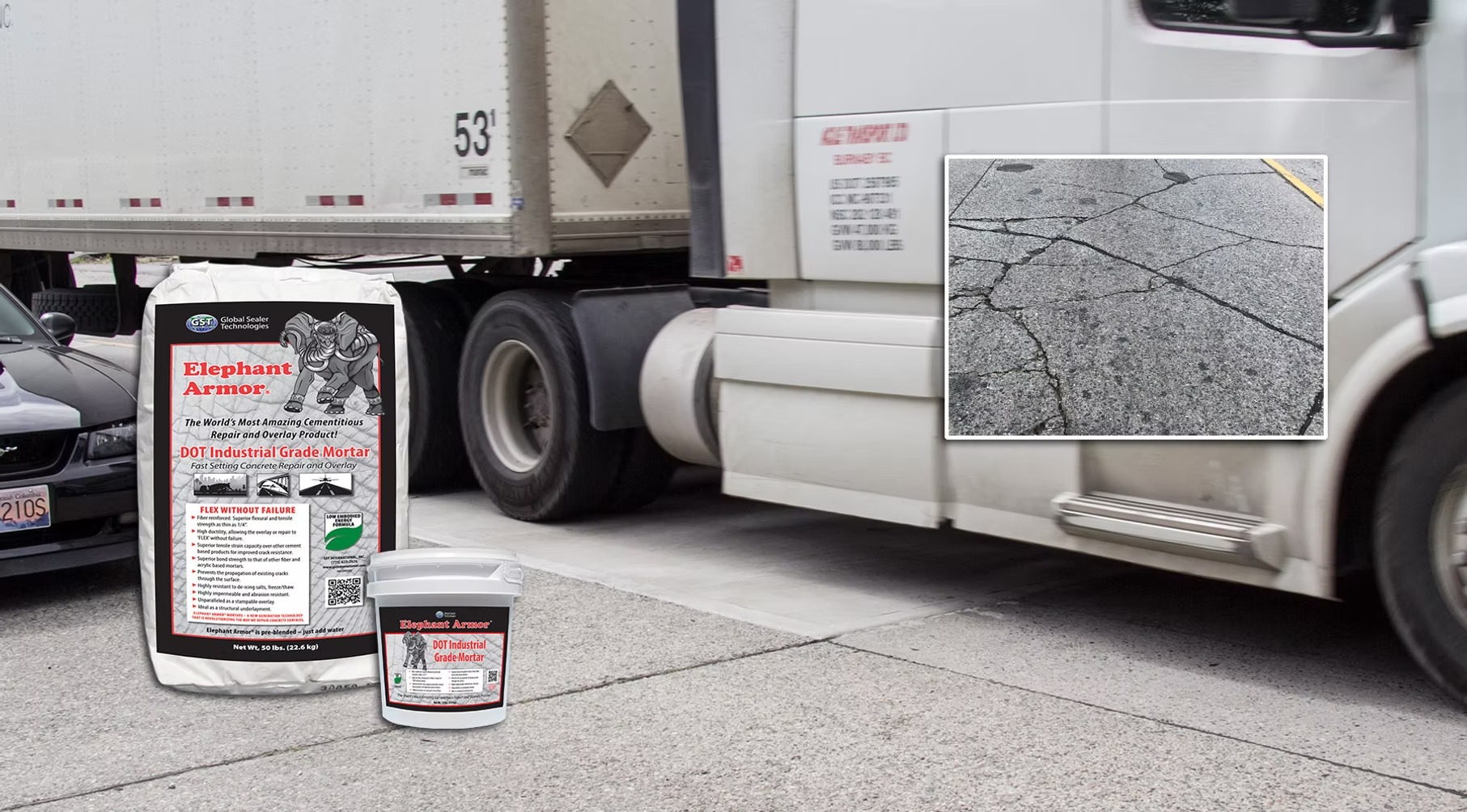
Elephant Armor is a single-component, fiber-based, zero-polymer, engineered ductal mortar—Just Add Water. In addition to a mechanical bond, its Polyvinyl Alcohol (PVA) fibers create a fully engaged molecular bond within the mortar matrix, providing extremely high tensile and flexural strength. It is highly ductile ("Flex Without Failure"), resists de-icing salts and freeze/thaw, and inhibits crack propagation.
What is the PSI rating and curing speed of Elephant Armor?
Elephant Armor DOT
Elephant Armor achieves over 4,000 psi in just 4 hours, allowing rapid return to service. Its ultimate 28-day strength reaches approximately 7,000 psi.
What is the exact water mixing ratio and mixing procedure per 50 lb bag?
Elephant Armor DOT
Consistency is critical: use exactly 5.5 to 6.5 quarts (5.2 to 6.2 liters) of clean water per 50 lb bag—no more. Pour all water in at once; it does not need to be slowly mixed in. Two bags (100 lbs) can be mixed in a GST EA 70 Quart Mixing Bucket in less than 90 seconds. Excessive water or over-working will cause fibers to be exposed on the surface.
Why is a ColloMix Xo55 Duo mixer strictly mandated over standard Hippo mixers or drills?
Elephant Armor DOT
Due to Elephant Armor’s high fiber content, high shear is required to achieve a homogeneous mix. The ColloMix Xo55 Duo is strictly mandated. Standard Hippo mixers, cement mixers, or 1/2-inch drills cannot provide the necessary shear and must NOT be used.
Does Elephant Armor need to be "fluffed up" prior to mixing?
Elephant Armor DOT
Yes. Due to transportation and storage, the material may become compacted. Roll the bag prior to emptying it into the GST 70 Quart Mixing Bucket. Before adding water, dry mix ("fluff") the material using the ColloMix Xo55 Duo to ensure proper water integration.
What special tools and techniques are required to spread and finish Elephant Armor?
Elephant Armor DOT
You must use a GST Texture Roller (looped roller) to spread the material; a metal trowel will pull and grab the material away from the substrate, whereas the roller forces it into the pores to ensure a proper bond. Use a GST Squeegee Trowel for initial finishing. Standard cementing tools can be used once the mortar achieves initial set.
What is the recommended thickness for overlays, and can it be stamped or broomed?
Elephant Armor DOT
Elephant Armor is highly structural at 1/4-inch to 1/2-inch thickness. It accepts all standard textures including stamped, broomed, or smooth squeegee finishes. For overlays thicker than 1/2 inch, consult your local representative.
What is the recommended practice for deep fills greater than 2 inches or deep small spalls?
Elephant Armor DOT
For small spalls exceeding 2 inches in depth, you can fill in a single pass as long as the diameter does not exceed 12 inches. For larger deep fills, use the "Fill and Cap" method in at least two layers, with the final cap not exceeding 1/2 inch thick. Because Elephant Armor creates exothermic heat in volume, timing is critical: if the initial fill hasn’t generated heat or set, place the cap immediately. If heat has begun, wait until the initial fill has fully set and cooled completely before capping so you do not "cook" the top layer.
Can Elephant Armor be used for vertical/overhead repairs, reverse-casting, or paver overlays?
Elephant Armor DOT
Yes. It is used extensively on bridges, tunnels, and seawalls for vertical/overhead repairs. It can be reverse-cast for countertops and outdoor kitchens. It can also be placed over unsealed segmental paver systems by pouring a flowable "wet fill" mix into the chamfers to lock pavers down, followed immediately by a 1/4-inch overlay.
What crew size is recommended for multi-bag or pallet-scale projects?
Elephant Armor DOT
For larger pours, use a crew of at least 5 people with dedicated tasks: at least 1 person dedicated strictly to mixing, at least 2 people focused on placing and finishing, 1 floater responsible for cleaning tools and supporting the crew, and 1 dedicated project supervisor.
Do I need to use an EA Primer, and how do I prepare the substrate?
EA Primer
Surfaces must be clean, sound, and free from bond-breakers (oil, grease, dirt, acids, curing compounds). You must prepare the surface using either an EA Primer Slurry Bond Coat or the Saturated Surface Dry (SSD) method.
How do I prepare and apply an EA Primer Slurry Bond Coat?
EA Primer
Mix 2 parts Elephant Armor dry powder to 1 part EA Primer. Apply to the clean substrate using a roller or stiff masonry brush, paying special attention to corners and exposed rebar (which should be treated with a rust inhibitor first). This application conforms to ASTM C 1059-13, Type II structural bonding requirements.
What is the most critical application warning for the Slurry Bond Coat?
EA Primer
CRITICAL WARNING: Whether applied NEAT or as a slurry, failure will occur in the form of a bond-breaker if the primer is allowed to dry or puddle/pool before placing the Elephant Armor mortar. It must remain wet and tacky to retain substrate moisture and ensure proper bond development.
How does the Saturated Surface Dry (SSD) method work with Elephant Armor?
EA Primer
Clean the repair area of all debris and organic stains. Thoroughly dampen the surface with clean water, but ensure there is zero standing water or pooling prior to placing the Elephant Armor.
Is Elephant Armor an exothermic material, and how does temperature affect curing?
EA Delay
Yes, Elephant Armor generates heat as it cures. Heat, volume, and direct sunlight will expedite the curing process and cause the mortar to stiffen quickly.
How can mixing water temperature be used alongside EA Delay to manage working time?
EA Delay
In hot summer months, use ice-cold mixing water alongside EA Delay to extend working time. In cold winter months, use warmer mixing water to expedite the exothermic curing process.
How is Ecobeton Vetrofluid used to prepare severely degraded concrete before repair?
Vetrofluid
Vetrofluid penetrates existing concrete to an average depth of 1.5 inches (and up to 3 inches on new concrete) to seal pores and form a permanent crystalline barrier. For severely degraded substrates, apply Vetrofluid first to restore stability and integrity to the concrete. Allow at least 72 hours for it to cure before initiating the Elephant Armor repair.
Why must Vetrofluid be applied as a post-cure treatment over cured Elephant Armor?
Vetrofluid
Approximately 2 hours after Elephant Armor achieves final set (indicated by a lightening in color), apply a light coat of Ecobeton Vetrofluid using a low-pressure pump sprayer. This provides an extra layer of permanent waterproofing and significantly enhances bond longevity.
What is the correct way to mix Surface Armor™?
Surface Armor
First, Elephant Armor Primer is diluted to a 1:1 ratio with clean water to create the required liquid mixture for Surface Armor™. The standard mix for most applications ranges from 1:1 to 2:1, meaning 2 parts Surface Armor™ dry powder with 1 part EA Primer/water mixture, by volume (not weight). Adjust your ratio based on required flowability: use 3:1 for initial spall/crack filling, 2:1 for standard second coats, or a highly flowable 2:1 for thin micro-fractures under 1/8" (4mm). Mix dry contents in a clean bucket to "fluff" the material prior to adding liquid. Add liquid and mix thoroughly using a ColloMix Xo-55 Duo for ~60 seconds. For small batches of 10 lbs (4.5kg) or less, a 1/2" (12mm) drill with an egg beater bit is acceptable. NOTE: Surface Armor™ has a short workability period with an initial set time of 15-20 minutes.
How do I prepare the damaged substrate before applying Surface Armor™?
Surface Armor
Surfaces must be clean, sound, and free from bond breakers (oil, grease, dirt, curing compounds, acids). Mechanically roughen or high-pressure water jet (4,500 psi minimum) the concrete to an ICRI Concrete Surface Profile of CSP4 or higher. Pre-treat contaminated areas with GST Degreaser Pro or Pro-Grade Cleaner, followed by power washing. If the substrate is very porous or powdery, apply a mist coat of Ecobeton® Vetrofluid SA at 250 sq ft/gal to stabilize the surface. Allow 72 hours curing time on warm days (or a MINIMUM of 5 days if weather averages 50°F / 10°C or lower) before placing Surface Armor™. Power wash rinsed contaminants prior to placement. The concrete must be Saturated Surface Dry (SSD) with zero standing water. NOTE: Minimum temperatures for application and curing must be 40°F (5°C) or higher day and night; freezing temperatures cause failure. In cool weather, keep primer and powder at room temperature, or use a torch to warm the substrate.
How is Surface Armor™ applied and what is the maximum lift thickness?
Surface Armor
Once clean and Vetrofluid SA has cured, apply the first micro-topping lift. Over-application is very common; keep mil build to a minimum. Use firm down-pressure with a squeegee trowel to apply maximum lift thicknesses of 1/32" to 1/16" (1-2 mm). For exposed aggregate or heavy textures, use a stiff bristle concrete broom instead of a squeegee. Allow first lift to fully cure (change color) before applying a second lift. Ensure Surface Armor™ is 100% cured before applying the final light coat of Vetrofluid SA.
Are there special instructions for vertical surface applications?
Surface Armor
Use a 3:1 mixing ratio on vertical surfaces to prevent runs or streaks. Work the material from bottom to top using a GST Squeegee Trowel. On stairs, complete vertical risers before horizontal treads. Use a damp sponge or paint brush to blend transition areas while material is fresh. You can also mist with water and use a smooth roller or brush for finishing.
Can textured finishes (smooth, broomed, or stamped) be applied?
Surface Armor
Yes. Smooth Finish: Mandates two thin coats applied with a squeegee trowel, followed by diamond pad sanding once cured (higher grit = smoother finish), clean dust, and seal with Vetrofluid SA. Broomed Finish: Perform immediately on the final coat as it is squeegeed into place; provides excellent slip resistance. Stamped Finish: Mandates a thicker mil build using a 3:1 mix ratio on the final coat with standard liquid release ("bubblegum release"). CRITICAL: If staining a stamped finish, do NOT apply Vetrofluid SA; use traditional film-forming acrylic sealers instead.
Can Surface Armor™ be used to resurface asphalt?
Surface Armor
Yes, Surface Armor™ is a highly effective asphalt resurfacer for aging asphalt with minor cracking (do not use on severely degraded or alligatored asphalt). Ensure asphalt has NO previous coatings or sealers, and is thoroughly clean and dry. CRITICAL EXCEPTIONS FOR ASPHALT: 1. Do NOT use Saturated Surface Dry (SSD); asphalt must be dry. 2. Do NOT apply Vetrofluid SA as a pre-treatment on asphalt. Apply Surface Armor™ with firm squeegee down-pressure. Once the second coat is fully cured, apply a light post-treatment coat of Vetrofluid SA for a long-lasting finish.

Can't find what you need?

Chuck can provide full SDS sheets, mixing ratios, and project-specific technical support on request.

406-598-4684